Steel on the beaches is a specification problem
A metal roof twenty kilometres inland is mostly about workmanship. On the Northern Beaches it is about specification first and workmanship second, because the wrong screw on a beachfront roof will fail no matter how neatly it was driven.
Airborne salt is the reason. It settles on every surface, and where rain does not rinse it off it keeps concentrating: under eave overhangs, behind parapet walls, inside gutters, on the shaded side of a ridge. Add onshore wind that drives rain uphill into laps and flashings, and you have a set of conditions that punish any component chosen for an inland address.
That is why we ask where the house sits before we talk about profiles and colours. Call (02) 8000 1949 for a free inspection and a written quote.
Matching the steel to the exposure
BlueScope publishes exposure bands for marine environments, and the roofing figures are tighter than the walling figures because a roof collects and holds deposits that a vertical wall sheds.
| Distance from breaking surf | Published roofing guidance |
|---|---|
| Inside roughly 100 m | Stainless roofing products recommended for very severe coastal exposure |
| Roughly 100–200 m | COLORBOND Ultra steel, the recommended roofing material for severe marine coastal areas |
| Beyond that, no direct marine influence | Standard COLORBOND steel generally appropriate |
Two cautions on reading that table. First, the distances are manufacturer guidance, not a legal boundary, and BlueScope's own notes say actual performance depends on local conditions including prevailing winds and unwashed areas. Second, walling distances are different again, so a wall cladding recommendation cannot be read across to a roof. For a specific address the current BlueScope technical bulletin and warranty terms are the documents that matter, and we check them for the job rather than relying on a rule of thumb.
Practically, this means a house a street back from Dee Why Beach, a house on the headland at Whale Beach and a house at Beacon Hill are three different specifications even if they are getting the same profile and colour.
Fixings, flashings and cut edges
These are the three places a coastal metal roof actually fails, and they are the three places a cheap quote saves money.
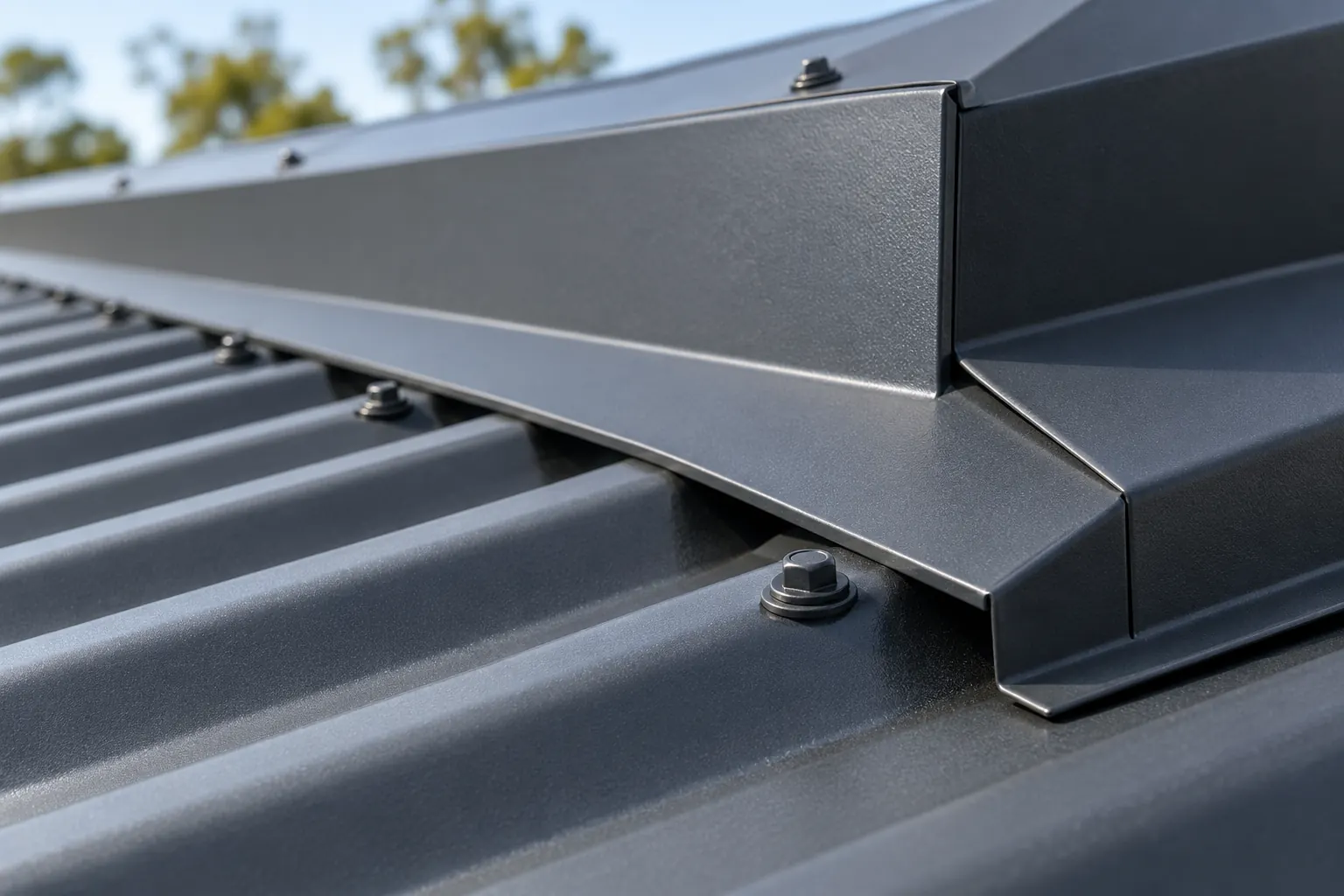
Fixings. Roofing screws are graded for corrosion resistance under AS 3566, and Class 4 is the normal coastal specification. Manufacturer guidance advises against relying on Class 3 fasteners within a few hundred metres of ocean or other severe marine influence. Washers matter too — manufacturers call for washers that will not react with the sheeting. Mixing metals is not a detail you can eyeball: stainless fasteners, for instance, are not compatible with standard or Ultra Colorbond sheeting, so "more stainless" is not automatically better.
Flashings and cappings. Ridge, barge, apron, valley and parapet flashings are usually where wind-driven rain gets in. The lap needs enough overlap and the right turn-up for the exposure, and on a parapet or box gutter detail the upstand height is not negotiable. On an exposed roof we would rather over-specify the flashing than rely on sealant to hold the line.
Cut edges and swarf. Every cut sheet end exposes raw steel, and every drilled hole throws metal swarf onto the finish. Swarf left on a roof rusts in place and leaves permanent staining and pitting. Sweeping the roof down at the end of each day is boring, unglamorous and the difference between a roof that looks right in five years and one that does not.
Profiles, pitch and what suits which house
- Corrugated sits comfortably on older cottages and renovations through Freshwater, Narrabeen and Avalon Beach, and suits the traditional look of a weatherboard or fibro beach house.
- Trapezoidal and concealed-fix profiles handle lower pitches and longer runs, which is why they turn up on the modern rebuilds at Whale Beach, Palm Beach and the newer Warriewood Valley houses. Concealed fixing also removes exposed screw heads from the weather face.
- Standing seam and tray profiles suit architectural low-pitch and curved work, and the detailing at penetrations becomes the critical item.
Minimum pitch is set by the profile, not by preference. Take a profile below its rated minimum fall and water will find the laps, which is a leak that no amount of sealant fixes afterwards.
Replacing a tile roof with sheeting
This is one of the most common jobs on the older ridge suburbs, and it is worth understanding what the work involves.
- Strip and dispose of the existing tiles, which is substantial tonnage off a 1960s house.
- Inspect the exposed structure. Rafters, battens and ceiling framing get checked while they are visible, and anything that has been wet under a failed valley gets dealt with now rather than covered up.
- Re-batten or re-space to suit the chosen profile.
- Lay sarking or an appropriate membrane. On bushfire-prone land, AS 3959 requirements for the roof system apply, and roof coverings must be non-combustible across all BAL ratings.
- Sheet, flash and fix with hardware matched to the exposure band.
- Reconnect or renew gutters and downpipes, and clean the roof down.
The weight reduction is the headline benefit. The quieter benefit is the drop in ongoing maintenance, because there is no bedding and pointing to renew every couple of decades.
Bushfire-prone land on the inland side
Frenchs Forest, Belrose, Forestville, Allambie Heights, Elanora Heights and Church Point all include land that sits against national park or mapped bushland. Where a property is on bushfire-prone land, construction has to meet AS 3959, which for roofs means non-combustible coverings, full sarking on tiled roofs across the common BAL ranges, and attention to every gap an ember could enter — ridge and barge junctions, valley ends and gutter lines. Metal sheeting handles this well, but only if the detailing is done to suit; a correctly graded roof with an open ridge gap is not an ember-resistant roof.
Costs and the quote
Sheeting cost is driven by roof area, profile, the grade the exposure requires, the amount of flashing the roof form needs, pitch, access, and whether structure or battens need work once the old covering is off. A low-pitch rebuild with three parapets and a box gutter carries far more flashing per square metre than a simple gable.
We inspect free, quote in writing, and the completed work carries a written workmanship warranty. Work is carried out by established, licensed and insured roofing contractors working to NSW Fair Trading requirements.
Call (02) 8000 1949 or send the form. If the roof is tile and still sound, ask about restoration before committing to sheeting, and see where we work for the full suburb list.