When another patch stops being worth it
Most people do not decide to re-roof. They notice they have paid for three repairs in two winters, each one in a different part of the roof, and the fourth leak has just appeared. That is the real signal, and it means the roof has stopped failing at individual details and started failing as a system.
Other honest signs, in the order we usually find them:
- Tiles that no longer ring when tapped, because they have gone porous and are holding water rather than shedding it
- Ridge pointing failing along the full length of every ridge and hip, not in isolated sections
- Rust perforation across whole sheets and at most sheet ends rather than at a few screws
- No sarking at all, which was normal on older beaches houses and leaves nothing between a slipped tile and your ceiling lining
- Sagging lines in the roof plane, which point at the structure beneath rather than the covering
- A roof that has been repaired so many times that it is now a patchwork of mismatched materials
Call (02) 8000 1949 and we will inspect it at no cost and put the finding in writing, including an honest view of whether restoration would get you there more cheaply.
Three house types, three different re-roofs
The Northern Beaches housing stock runs across about seventy years of building practice, and the job changes completely between them.
The original beach cottage
Fibro and weatherboard cottages, many of them modest and some now the last of their kind on the street, survive right through Freshwater, Curl Curl, North Curl Curl, Narrabeen, Newport and Avalon Beach. They were built light, often with minimal or no sarking, simple pitched forms and timber that has been in salt air for decades. Stripping one of these almost always turns up something: a rafter end that has been wet for years under a failed valley, or battens that will not hold a new fastener. These are the jobs where the written quote has to be explicit about what might be found underneath.
The split-level 1970s brick house
The dominant form through Beacon Hill, Narraweena, Cromer, Allambie Heights, Frenchs Forest, Seaforth and Bayview. Concrete tile roofs over multiple planes at different levels, with internal gutters or valleys where the levels meet, and a lot of hip and ridge length relative to the floor area. The ridge and valley detailing is where the money is on these, and the tiles across a whole suburb of them tend to reach end of life within a few years of each other because they went on at the same time.
The modern coastal rebuild
Avalon Beach, Whale Beach, Palm Beach, Bayview, Seaforth and the newer Warriewood Valley estates are full of them. Low-pitch and parapet forms, concealed box gutters, large glazed openings interrupting the roof plane, and sheeting that depends entirely on correct flashing and drainage. These leak in a different way: with little fall, water sits, so an undersized outlet or an under-lapped junction becomes a leak rather than a slow drain. Replacing one of these is a drainage design job as much as a roofing job.
Tile or metal on a coastal block
Neither is automatically right, and the distance from breaking surf matters more than personal taste.
Concrete or terracotta tile keeps the look of the street, takes impact from falling limbs better, and does not corrode. Against it: weight, the ongoing pointing and bedding maintenance, and the fact that every tile roof has thousands of individual joints that rely on being correctly laid.
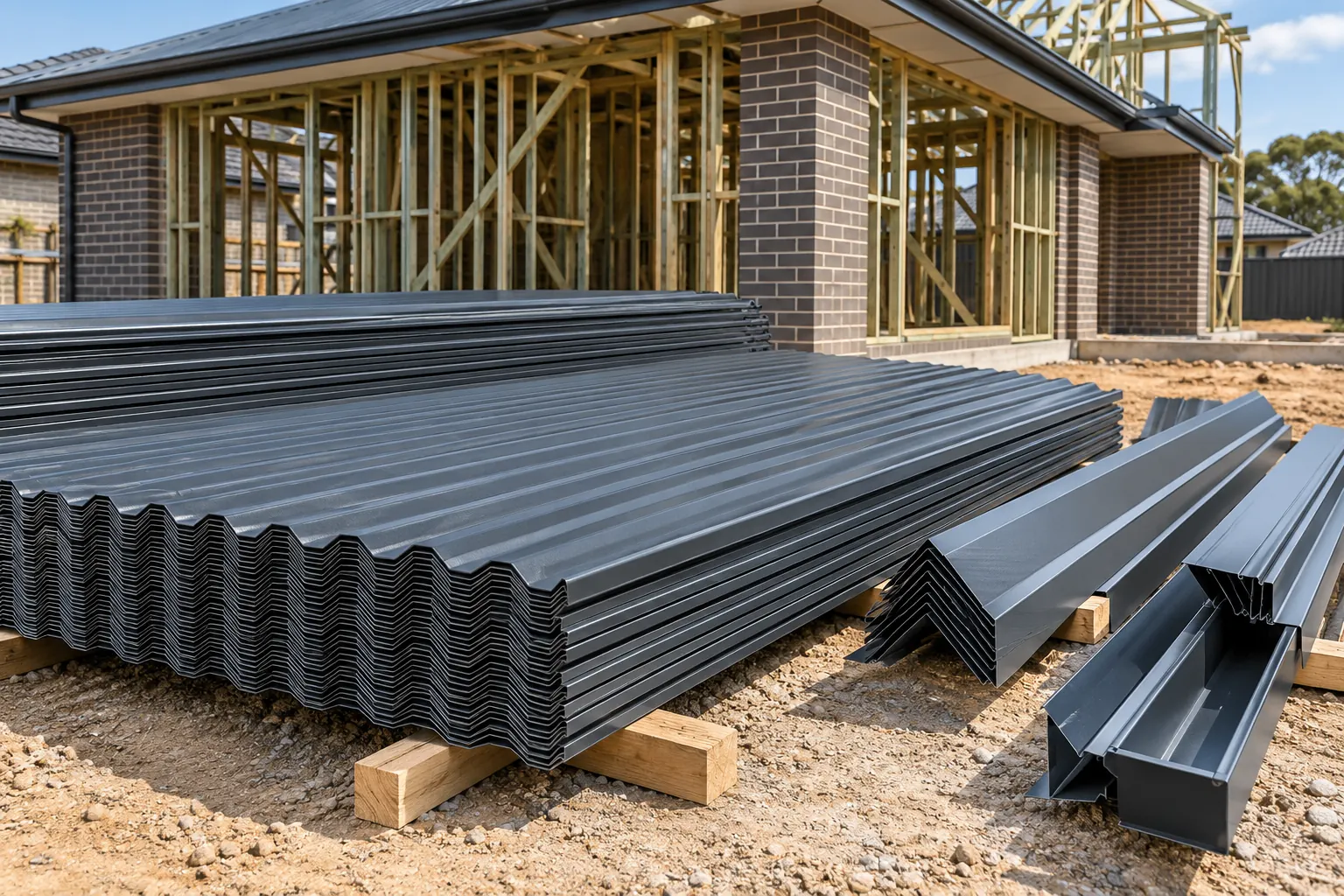
Colorbond and other steel sheeting goes on faster, weighs much less, works at lower pitches and carries far fewer joints. Against it: it is metal in a marine environment, so the grade and the fixings have to be right. BlueScope publishes guidance for severe marine exposure, broadly pointing to Colorbond Ultra for roofing in the range of roughly 100 to 200 metres from breaking surf and to stainless products closer in than that. Fastener standards follow the same logic — Class 4 coated fasteners to AS 3566 are the normal coastal specification, and manufacturer guidance warns against relying on Class 3 within a few hundred metres of surf. Full detail is on the metal and Colorbond roofing page.
On the bush side the questions change. On bushfire-prone land, AS 3959 requires non-combustible roof coverings, and for tiled roofs across the common BAL ranges the roof has to be fully sarked, including over ridges and hips and extending into gutters and valleys. That is a cost line, and it is also why a re-roof at Belrose or Frenchs Forest is not the same quote as the same house at Dee Why.
Paperwork worth sorting before the crew arrives
- Council. Like-for-like replacement is frequently exempt, but heritage listings, conservation areas, bushfire-prone land and any change to roof form or material can all change that. Northern Beaches Council publishes the bushfire-prone land mapping and the planning controls that apply to your lot.
- Bushfire. If your property is mapped as bushfire-prone, the construction requirements flow from AS 3959 and the BAL assessed for the site. Get that confirmed rather than assumed.
- Strata. On a unit block or townhouse in Manly, Dee Why, Brookvale or Collaroy, the roof is usually common property, which means an owners corporation decision rather than an individual one. A written report helps that process along.
- Neighbours and access. Scaffold, skips and a crane lift for sheeting all need somewhere to go. On the narrow streets around Queenscliff, Fairlight and Whale Beach, that is worth arranging early.
What drives the quote
Roof area and the number of planes. Pitch. Whether the existing structure can carry the new system or needs work. Access, which on a steep Pittwater or cliff-side block can be a significant share of the job. The covering you choose and the exposure grade it has to meet. Whether sarking, insulation, ventilation or new gutters are part of the scope. And disposal, because a stripped tile roof is a lot of tonnage.
What we will not do is quote a roof over the phone. The inspection is free, the quote is written, and the completed work carries a written workmanship warranty. Work is carried out by established, licensed and insured roofing contractors working to NSW Fair Trading requirements.
Get the roof assessed
Call (02) 8000 1949 or request a quote. We re-roof across every suburb on the list, from Manly and Seaforth to Avalon Beach and Palm Beach.